


Most tourists in Italy head straight for the more famous Rome, Florence, and Venice, leaving little time for the south of Italy, colloquially known as the Mezzogiorno (literally the midday). And when they do visit the South, they live it up on the idyllic island of Capri or laze about at the resorts of Sorrento & the Amalfi Coast. The history buffs head off to check out the ruins of Pompeii, a Roman town buried by Mount Vesuvius, which erupted in 79AD. To get to these places, you’d have to get through Naples first. Sort of. Most get off the train and immediately leave Naples by bus or the circumvesuviana, a rickety old commuter train. This is a big mistake.
Naples gets a bad wrap: some say it’s dirty. Unsafe. There’s nothing to see. The traffic will leave you with whiplash. But nothing could be further from the truth (with the exception of the traffic!). Naples is festooned with treasures, and is the perfect place to visit if you’re curious about the many layers of Mediterranean history. I guess it makes sense, then, that the seventeenth-century Italian Giulio Cesare Capaccio once wrote that “Naples is the whole world.”
And in the age of the Grand Tour, when rich European dandies went to Italy to polish off their classical education, Naples was the final stop on a whirlwind voyage. The eighteenth-century German writer Goethe claimed that “vedi Napoli e poi muori”—see Naples and die. Apparently, Goethe and so many others found it so beautiful that, after seeing Naples, there was little else left to live for.
It’s no wonder that so many authors found Naples so beguiling. It has so much history! Naples, originally called Neapolis (New City), was founded by Greeks in the second millennium before Christ (so, more than 3000 years ago), making it older than Rome. Over the centuries, it passed hands from Greeks to Romans, back to Greeks; then the French and Spanish had a turn. Each left its mark on the city, in the form of churches, palaces, and even castles.
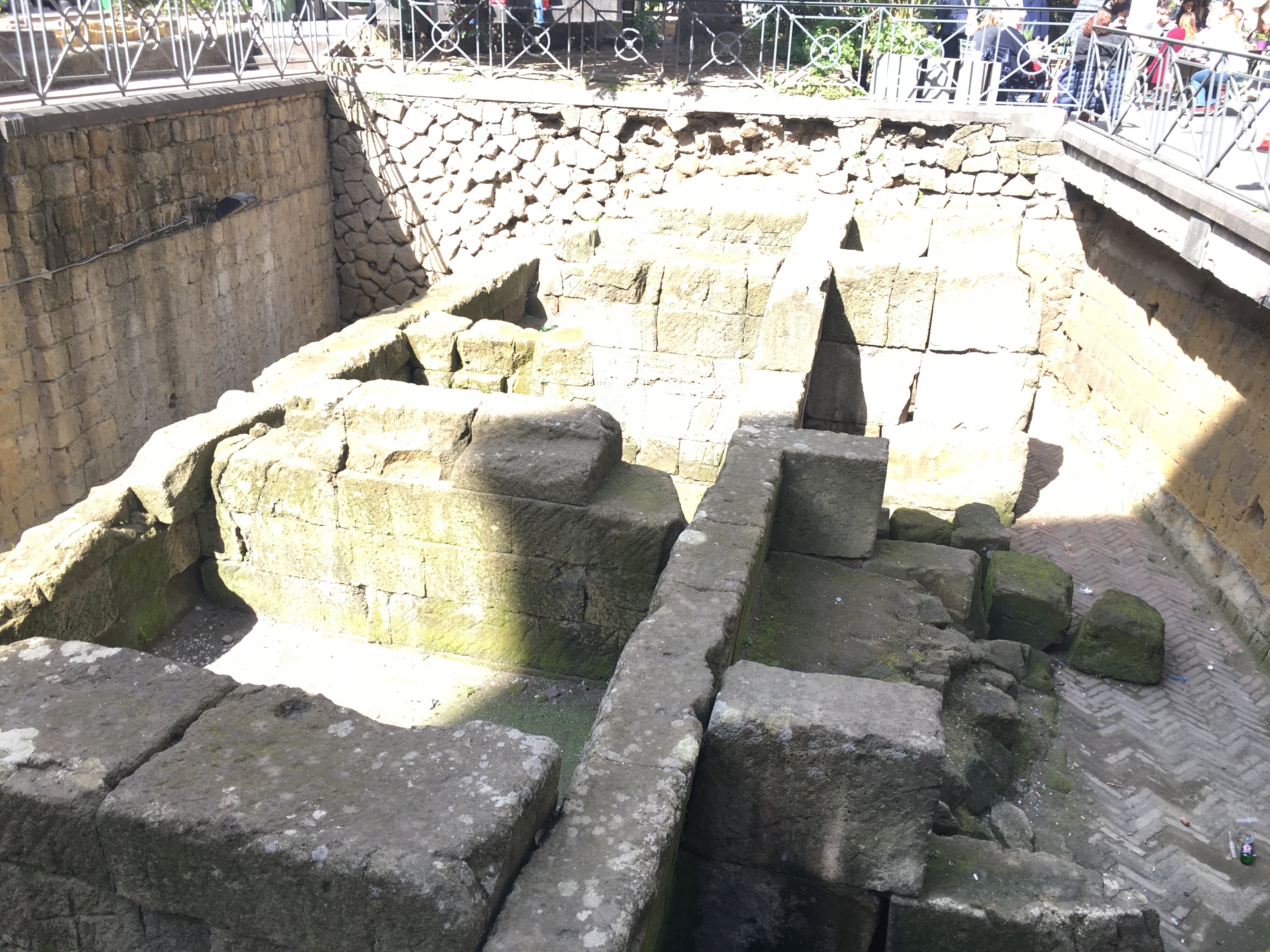
Despite its many layers of history, you still navigate Naples via its old Greek street plan, which was a grid. And if you look closely, every so often, Greek ruins peek out between the various alleys and palaces that make up the tightly packed city. Here are some remnants of walls that protected Greek Naples from invaders.
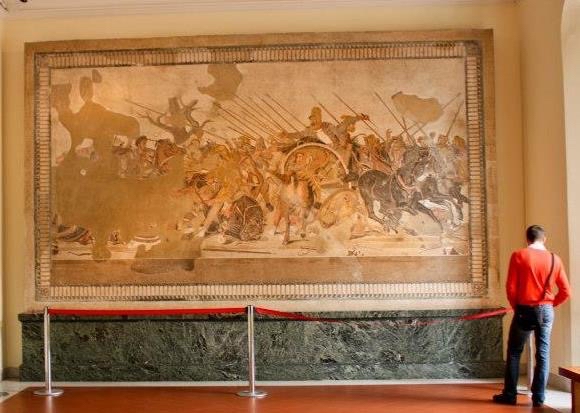
The real gem of Naples is its classical art collection, housed in the National Archaeological Museum, which is full of amazing artifacts from Pompeii and other points throughout the ancient world. Because Naples is often overlooked, so too is this wonderful museum. There’s almost never a crowd, meaning you get to spend all the time you want meandering about some of the most beautiful sculptures, paintings, and mosaics from the ancient world. Here’s me as a young, naïve grad student standing before a mosaic of Alexander the Great, the famed Macedonian general who nearly conquered the whole known world. I’m pretty tall, just over 6 feet. Clearly, this is no small object d’art.
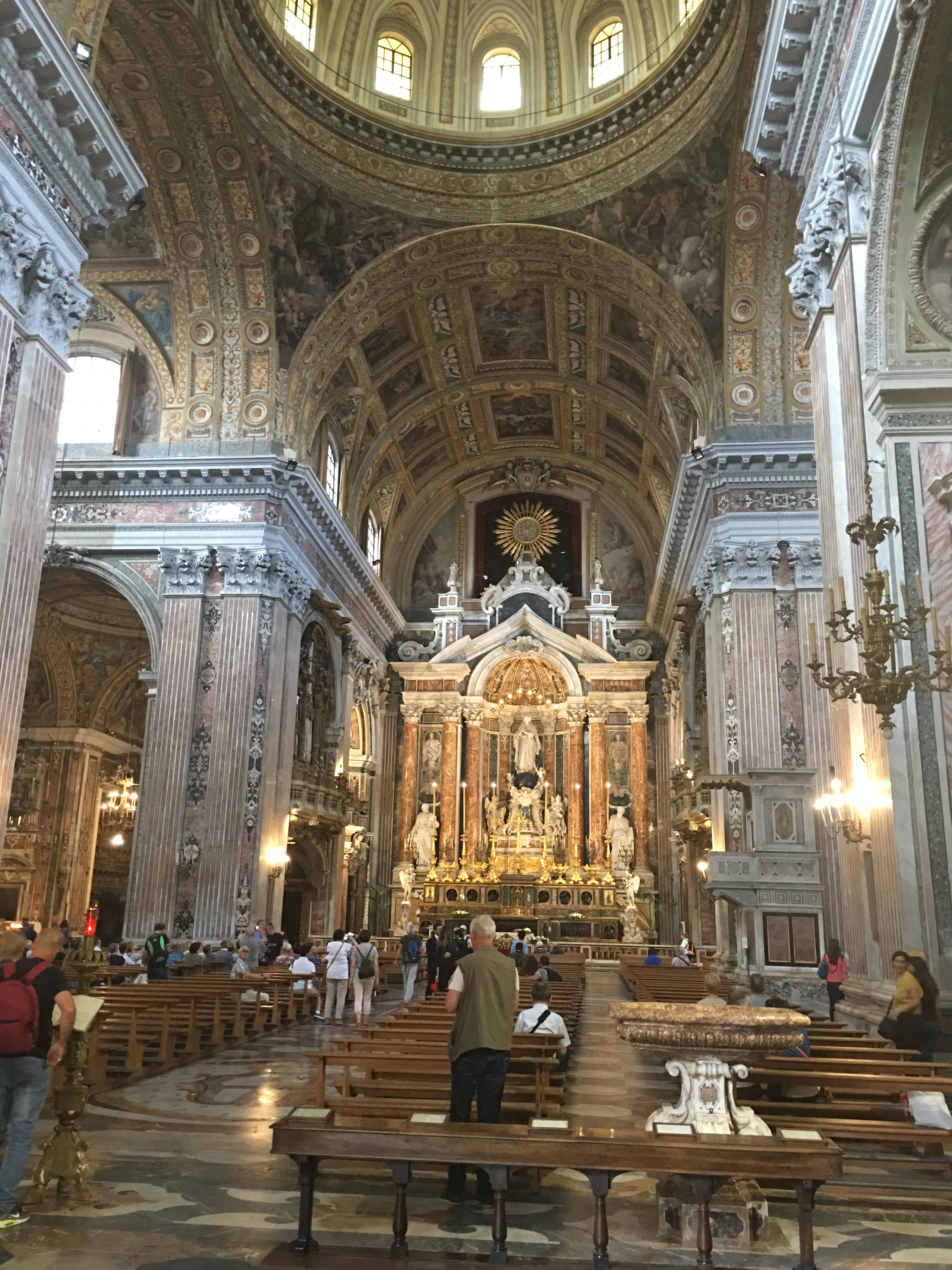
But the archaeological museum is only the beginning. Naples is full of plenty of museums to check out, as well as a seemingly endless number of baroque churches, such as the Church of the Gesù Nuovo (the New Jesus). Just look at all of the gold, marble, and porphyry. Churches like this are stunning in person, and these photos do them no justice. One of the best things to do in Naples is to wander around and pop into any church that’s open. You won’t be disappointed. In the sixteenth and seventeenth centuries folks sure knew how to decorate churches.

But beyond the art and architecture with Vesuvius looming in the background, Naples offers perhaps the best thing about the Mediterranean: FOOD. In particular, nothing says Naples like a true Neapolitan pizza. Pizza has a long history, perhaps as old as the Mediterranean itself. Various Mediterranean civilizations consumed similar flatbreads (think about how pita and pizza sound so alike!), but this has not stopped the Neapolitans from claiming that pizza is theirs. In fact, they’ll even tell you that their northern countrymen simply don’t know the first thing about pizza. And don’t you dare ask for pineapple on your pizza.
It may seem somewhat pedantic to argue about pizza, but until you actually have a true Pizza Napoletana, it is best to remain silent on the matter. And once you do get your pizza, odds are your mouth will be too full to weigh in anyhow.
Perhaps, in the end, it is true that if you see Naples, you’ll want to die. But not because it’s dangerous or not worth seeing. If anything, after exploring Naples and eating a pizza, your life just won’t ever be the same.
 Robert Clines, Ph.D.