
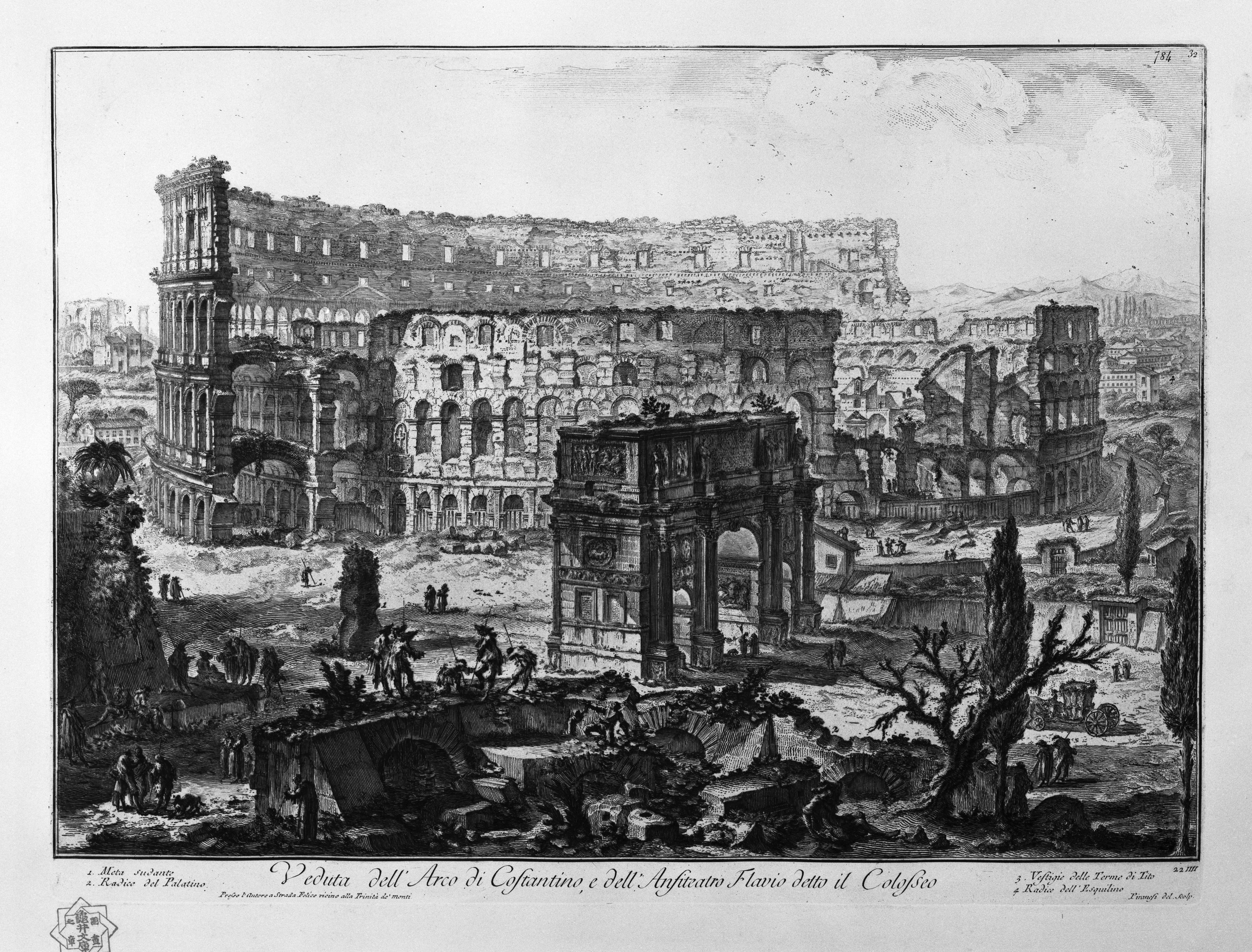
Yesterday, Kristi Cheramie and I submitted our paper on debris at the Colosseum, which we will present together in Providence, RI, at the annual meeting of the Society of Architectural Historians this April. Kristi and I have been working on the state of the Colosseum and the ancient Roman Forum in the early modern period (roughly 1350-1850). Much of our work centers on learning as much as we can about these ruined sites through our research of both historical and literary evidence as well as what we know about Rome’s built environment and climatic shifts over the centuries.
It’s a fun project. Much of this has taken me far outside my typical area of research into the Mediterranean. I’ve read a lot about seismography (the study of earthquakes), plant life, and early modern climate change. By linking this up with my knowledge of literature, history, and art, we’re trying to get a sense of how Rome and its ruins seemed to their visitors. From this pretty large corpus of data, we create hyperrealistic photo-quality approximations of what Rome probably looked like. Think of these images not as real-life snapshots of real events, but as approximations of what you might have expected to see at any given moment in the past.
This hasn’t been easy. Most of the time, the evidence is cryptic or really over the top. Take the famed humanist Petrarch. He claimed that “When we passed through the walls of the shattered city and sat there, the fragments of its ruins were before our eyes.” Of course they were. They still are. But what does Petrarch mean? What could Petrarch see? He never really tells us what he saw in particular, other than to say that “the houses are laid low, the walls tottering, the temples collapsing.” Not very helpful.

But art can help. Pinturicchio’s painting of the Martyrdom of Saint Sebastian is one of my favorites. Sebastian was what they call a paleochristian martyr, an early Christian who died for his beliefs at the hands of the ancient Romans. For him, that was around the year 288. But look at the Colosseum: that is not the Colosseum of 288. More like 1492-1494, which is when Pinturicchio worked on this painting, among others, for Pope Alexander VI. While Pinturicchio may have been painting a third-century event, the backdrop is from his own time. Images like this help Kristi and me get a sense of what we might expect the Colosseum and other ruins in the city to have looked like.

Maps help with the environs. Nolli’s 1748 map, for example, lets us know what types of buildings surrounded the Colosseum. In the lower right is the Colosseum. Hard to miss. To the upper left, where Rome’s ancient temples and meeting houses should be, we see the words CAMPO VACCINO, which means cow field in Italian. That’s what the Roman forum was by the eighteenth century—a cow pasture!
We then combine all this with anecdotes from various texts. The fifteenth-century historian Flavio Biondo, to give you a sense of things, claimed that “all of the buildings of the church and the monastery of Santa Maria Nuova, and all of the ruins around the Colosseum, were part of the said Temple of Peace.” He allows us to figure out how close things were to one another, which we can compare to things like Nolli’s map, to get a better sense of how to reconstruct our images.
To accompany our images, we’re also writing what I like to call a cultural history of Roman ruins. Essentially, we use what people have said about ruins to get a sense of who they were. It’s a weird idea, but it works. The way we describe the world tells us a lot about what we see. But it also tells us much about ourselves. The past is no different. How people talked about what they saw in Rome is as much about the state of the city’s ruins as it was about their own states of mind.
But more on that in time. I’m not going to give everything away. If you want to see our images, you’ll just have to come to Providence in April. Rhode Island is hardly the Mediterranean, but if you stare at our images long enough, maybe you’ll convince yourself that you’re in Rome.
 Robert Clines, Ph.D.