
The Mediterranean Sea seems like a constant for those of us who study it. Literally a constant, in the sense that it’s always been there and has certain features that transcend history. All of its connections and sinuous networks that tie peoples and civilizations together. But what if that weren’t always the case? What if the Middle Sea or the sea between land—which is what the Mediterranean literally means—was not that, but was a vast wine-dark (to quote Homer, the author of the famed Odyssey and Iliad) body that was more mysterious than welcoming?
How, then, do we come to speak of a Middle Sea, one that is not a barrier, but one that unifies and connects?
The most famous historian of the Mediterranean, someone that anyone who wants to study the Med must read, is a Frenchman by the name of Fernand Braudel. His The Mediterranean and the Mediterranean World in the Age of Philip II is a magisterial, two-volume exploration of the the Mediterranean’s larger historical processes that move beyond the realm of humanity. In other words, we don’t matter for Braudel. Rather, things like the shapes of mountains, the traces of rivers, and the climatic shifts that permit things like shepherds moving their flocks are the driving forces of human history and are the motors of the Middle Sea.
If you read this book, it’s sort of deflated. Fascinating, but deflated. Because, really, that’s it? We’re all just part of it with no say?
But that’s not the only work Braudel wrote.
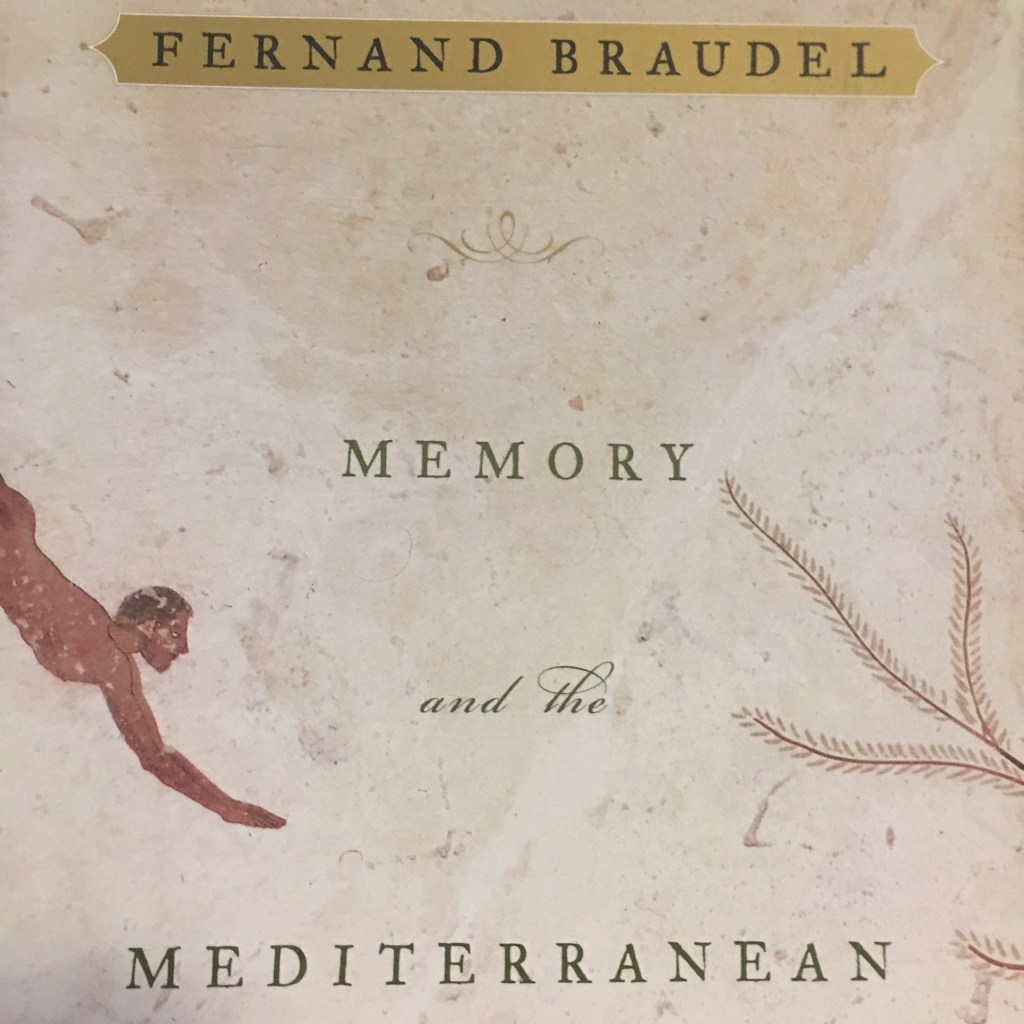
I recently revisited a personal favorite, one of Braudel’s fascinating yet relatively unknown works, Memory and the Mediterranean. Breaking from his more famous two-volume work, Memory and the Mediterranean surveys the Mediterranean from its fairly disconnected pre-historical roots to the Roman Empire, which unified the Middle Sea like never before.
What strikes me most about this book is that, despite his emphasis on unity in his more famous work, Braudel traces disunited, yet parallel pan-Mediterranean developments that are somehow both the hallmarks of early Mediterraneanisms yet not quite evidence of sea-wide unity. In other words, things happened across the Mediterranean because they were in the Mediterranean, but they didn’t happen because the Mediterranean connected them in the way we think.
Basically, networks and pan-thalassological (fancy-pants speak for across the sea) exchanges aren’t the only way that the Med connected people. There were other factors: climatic shifts, similar geologic experiences, and the birth of what we’d call civilizations that were not in contact yet were nevertheless in concert with one another.
It’s a fascinating approach, and challenges us to rethink the role that humans played in history. It’s easy to think that everything is determined, and we’re just along for the ride. Especially after reading Braudel’s famous and quite convincing tome. But in Memory and the Mediterranean, even Braudel admits, begrudgingly, that he’s not so sure about his previous thesis that our world isn’t so different from that of the ancient Greeks.
Maybe this causes us to question how much the structures of society makes us who we are. And maybe that can renew our sense of our own purpose in this world. I guess it makes sense that Braudel (or the editor of the U.S. version, anyhow) put “Memory” in the title of the book: the past isn’t some distant layer in a bowl of determinism that shaped the ancient Mediterranean and somehow also shapes our world. No, history is our for the making.
 Robert Clines, Ph.D.