
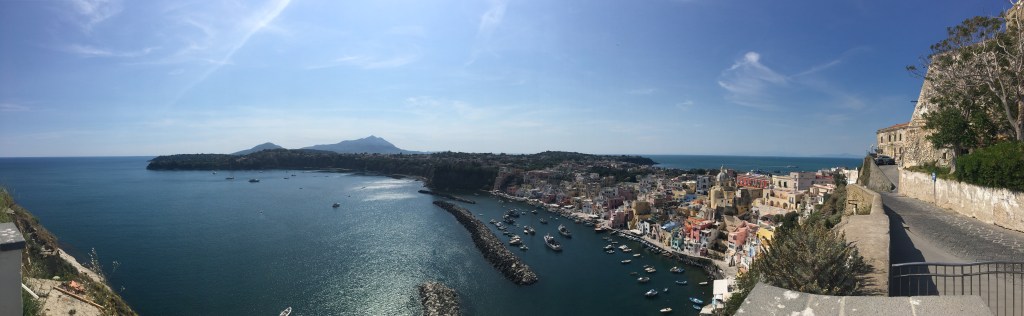
I’ve been thinking a lot about islands lately. I’m not entirely sure why, but it’s probably because the doldrums of the semester require me to drift off to some of my favorite places in the world, to think about what I could be doing if I weren’t wrapping up an essay, prepping students for exams, etc. This should come as a surprise to no one, but my favorite island is a Mediterranean one: Procida, an idyllic little crescent of land that inexplicable juts out of the water at the far western edge of the Gulf of Naples. Once overrun with sheep and lemons, it’s become more touristy as of late. I could rant about that (and there is a rant there!), but I’m in a sort of happy mood these days, so I’ll roll with that.
Islands are funny creatures, or perhaps we’re funny creatures given how we think of them. We think that islands exist in a bubble—they’re separate from real land, disconnected and somehow not really a part of the world as we know it. Even the way we talk about islands gives us the image of far-off lands that seem to float beyond our grasp, spaces that can only be reached by cruise ships, ferries, and, if you’ve ever watched an episode of Gilligan’s Island or seen Castaway, really really bad luck.
Think about how we talk in English. We say things like “so-and-so is so insular.” One of our words for being alone, isolation, is etymologically related to the word island. We also have the expression “to be out on an island,” which suggests you’re surrounded by an endless, vast sea that separates you from literally anything. In other words, you’re out of touch. And we say “desert island,” a place so remote that it’s completely unknown.

It even has odd uses. American football fans of the late 2000s might remember the shut-down cornerback of the New York Jets, Darrelle Revis. Revis was so dominant between 2007 and 2012 that he could completely close off an entire half of a football field for opposing wide receivers. This side of the field was seen as so dangerous and deserted that any receiver might get totally lost. And how was Revis described? As Revis Island, of course!
But is this true in the Mediterranean? Are the islands of the Sea between Lands no-man’s lands akin to Revis’s 26 2/3 yards of football field?
If you ever went to Melos or Sardinia or my beloved Procida, you’d see why it’s easy to think so. All it takes is a wistful stare out into the abyss that the Mediterranean can seem to be. Watching a sunset on Santorini, for example, can be awe-inspiring but also entirely isolating. There’s something about that anonymous expanse of sea that humbles us, makes us feel small, reminds us how alone we can often be in the world.
But if we dig a little deeper, islands are by no means random rocks peeping out of the Middle Sea.

Take Sicily, for example. In antiquity, it was festooned with Greek colonies, and Thucydides, the great historian of the Peloponnesian War, opined that the reason why Athens eventually lost the war was an ill-fated desire to invade an island that eventually became the desire of Romans, Carthaginians, Arabs, Byzantines, French, and Spanish. In the Middle Ages, at the court of Roger II—a northern Frenchman—one could find Catholics, Greek Orthodox, Jews, and Muslims working side-by-side. He even had a Muslim polymath from Spain named Muhammad al-Idrisi as his geographer. Roger wanted to use al-Idrisi’s knowledge of the Muslim world and his expertise in classical geography to better understand the nature of his realm and where it fit into the geopolitical landscape of the medieval Mediterranean.
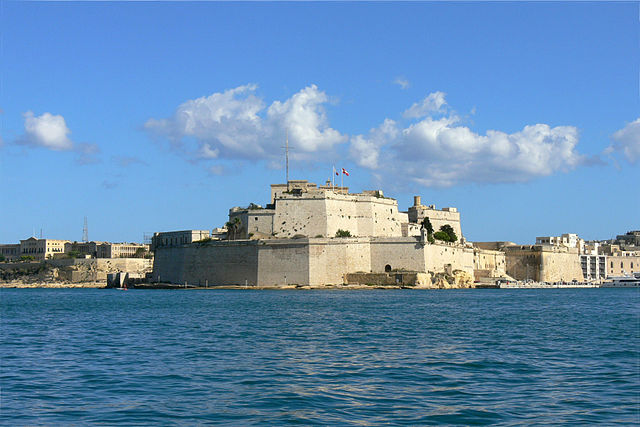
Or how about Malta? After the Order of Knights of the Hospital of Saint John of Jerusalem, better known as the Knights Hositaller, were driven out of Rhodes (another island!), Pope Clement VII and Emperor Charles V gave them Malta in the sixteenth century. They then operated as pirates and pursued Muslim ships (though also some Christian) throughout the Mediterranean. Despite the island’s tiny size, it exercised a lot of political power and influenced courts across Europe.

In both cases—Sicily and Malta—these islands were never disconnected from the wider world. If anything, they were the center of the Mediterranean World, places where cultures mixed, wars were fought, and differences were negotiated.
The Mediterranean is full of such islands—Corsica, Mallorca, Crete, Cyprus—that are not so much disconnected from the mainland as they are crucibles and friction points in which the cultures that surround the Mediterranean came too blows, accommodated differences, and influenced the world that surrounds them.
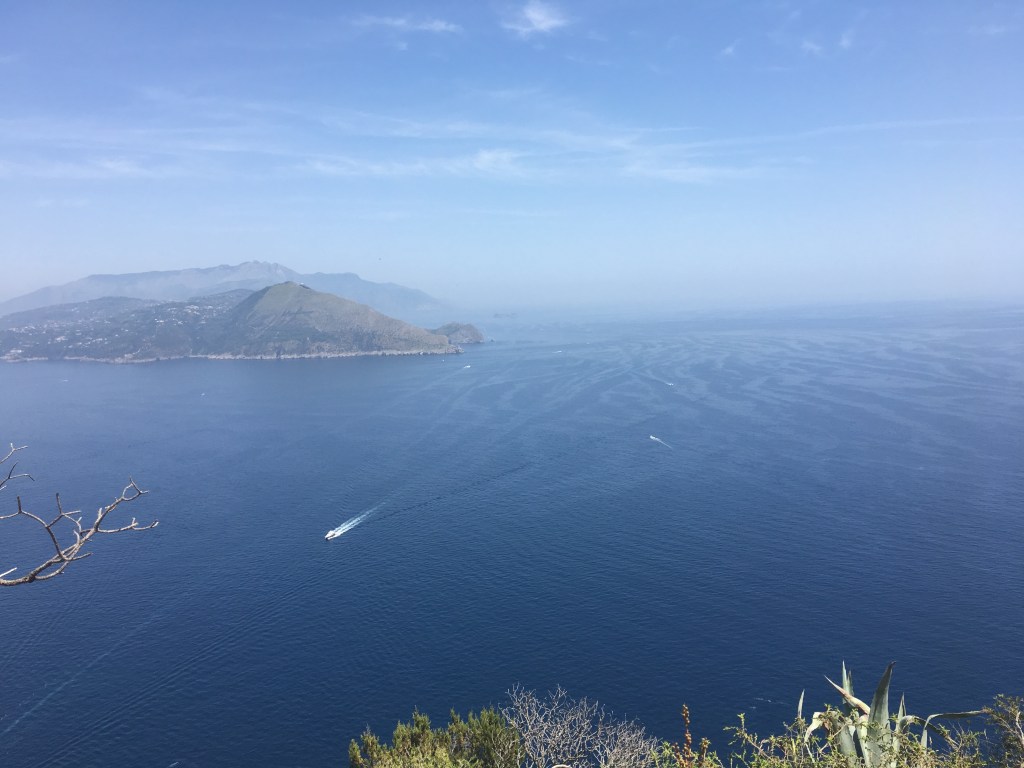
Maybe, when we say things like “on an island” or “to be insular,” we should mean one is surrounded by and always connected to a wider world, or is always tuned into the larger currents that define the times. Being isolated, at least in the Mediterranean anyhow, has nothing at all to do with being alone. The vast sea off Capri may give us this impression, and we’d be wrong not to stare off into the distance and wonder what’s out there. But what lies off in “the distance” is closer than you might think.
 Robert Clines, Ph.D.