
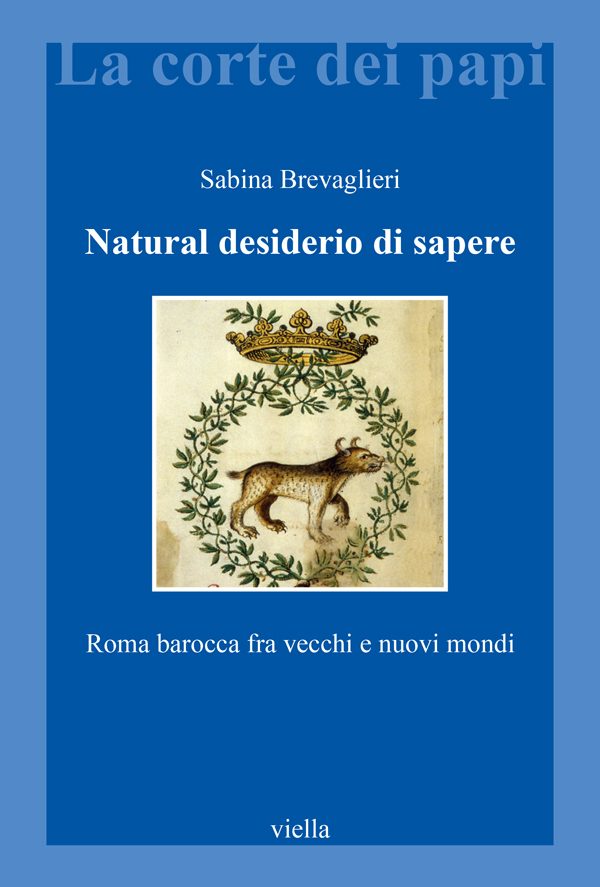
My recent review of Sabina Brevaglieri’s book, Natural desiderio di sapere: Roma barocca fra vecchi e nuovi mondi (The Natural Desire to Know: Baroque Rome between Old and New Worlds) will appear in the forthcoming volume of the academic journal Renaissance Quarterly. I really enjoyed reviewing this book because it paints a very different picture of Papal Rome after the Reformation than most imagine. Because of Counter-Reformation institutions like the Inquisition and the Index of Forbidden Books, there’s long been a belief that Rome in the age of the baroque was a contradictory city marked by cultural decadence and ornate, even gaudy and tasteless art on one hand and deep suppression of ideas that question the papacy’s stranglehold on society on the other. Brevaglieri shows that this is simply untrue, that baroque Rome was a dynamic and learned city.

Published by the Roman printing house Viella in 2019, Brevaglieri’s book explores the backstory to a text little known to non-specialists, the Tesoro Messicano, a compendium of knowledge relating to Mexican plants, many of which were believed to hold medicinal properties, which was compiled by Federico Cesi in Rome in 1651. Brevaglieri explores how intellectual life in Rome, the city’s connections to Naples, Germany, and the New World, and the increased desire to know more about the New World fueled interest in natural history, all of which led to the creation of the Tesoro Messicano.
Brevaglieri’s book shows that Rome was anything but a center for the suppression of ideas. Yes, Giordano Bruno was burned at the stake for heresy in 1600 (on my birthday!) and Galileo was placed under house arrest for some of his views. And they were not alone. But Brevaglieri reminds us that there was plenty of intellectual freedom and scientific inquiry taking place in the Eternal City. The Accademia dei Lincei, a sort of club for scholars and their patrons to share ideas about the natural world, was the center of intellectual life. But what’s most interesting to me is that this was no secret society. Its members were often heavily patronized by and connected to the power players themselves—popes, cardinals, nobles, rich merchants, famous artists. And they participated in these learned circles and were deeply interested in knowledge of the natural history of the New World.
Brevaglieri called this world a “mutable prism” of exchanges and dialogues driven by a mutual desire to know and a mutual desire to know more. Rather than seeing Rome as an isolated exception to global knowledge networks, Brevaglieri shows how intellectuals Rome was very much attuned to scientific discoveries, medical advances, and the movement of ideas across borders.
It appears that even when it comes to spreading knowledge about the natural history of the Americas, all roads really did lead to Rome.
 Robert Clines, Ph.D.